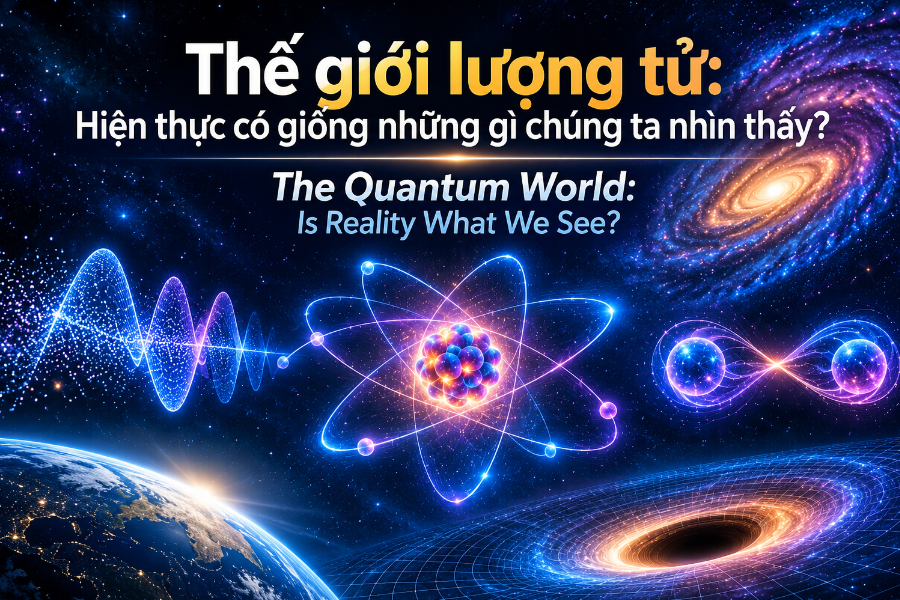
The Quantum World: Is Reality What We See?
Chúng ta thường tin rằng thế giới xung quanh tồn tại đúng như cách mắt mình nhìn thấy. Một chiếc bàn là một chiếc bàn. Ánh sáng là ánh sáng. Một hạt bụi là một vật thể nhỏ bé đang trôi trong không khí.
Nhưng khi các nhà khoa học bước vào thế giới cực nhỏ của nguyên tử và hạt hạ nguyên tử, những quy luật quen thuộc ấy bắt đầu trở nên kỳ lạ.
Ở đó, ánh sáng thể hiện tính chất của cả sóng và hạt. Các hạt lượng tử có thể tồn tại trong trạng thái chồng chập. Hai hệ lượng tử có thể có mối tương quan đặc biệt ngay cả khi cách xa nhau.
Và một câu hỏi thú vị xuất hiện:
Liệu thế giới mà chúng ta đang nhìn thấy có phải là toàn bộ hiện thực, hay chỉ là một phần của bức tranh rộng lớn hơn?
1. Khi thế giới không còn vận hành theo trực giác
Trong cuộc sống thường ngày, chúng ta quen với vật lý cổ điển. Một vật thể có vị trí, vận tốc và quỹ đạo tương đối xác định.
Nhưng ở cấp độ lượng tử, mô tả tự nhiên trở nên khác biệt.
Một electron không đơn giản giống như một viên bi tí hon bay quanh hạt nhân nguyên tử. Cơ học lượng tử mô tả trạng thái của nó bằng hàm sóng, từ đó xác định xác suất tìm thấy electron ở những vị trí khác nhau.
Điều này không có nghĩa electron là một vật thể ma thuật biến mất rồi xuất hiện ở nơi khác. Nó cho thấy trực giác hình thành từ thế giới vĩ mô không còn đủ để mô tả thế giới vi mô.
2. Một hạt có thể mang hai tính chất: Sóng và hạt?
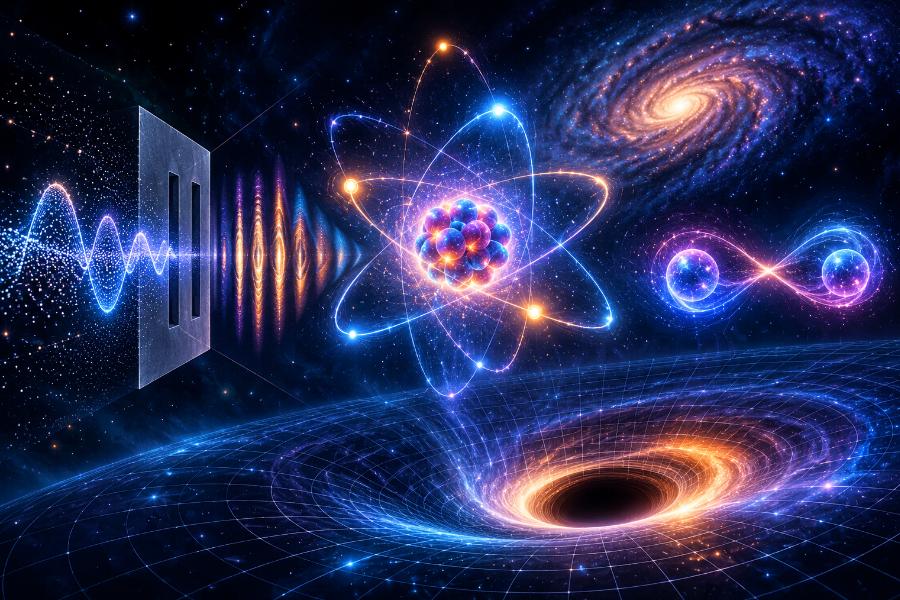
Thí nghiệm hai khe là một trong những minh họa nổi tiếng nhất của vật lý lượng tử.
Khi chiếu các electron qua hai khe hẹp, chúng có thể tạo ra hình ảnh giao thoa đặc trưng của sóng, ngay cả khi từng electron được ghi nhận riêng lẻ trên màn hình.
Khi thiết lập thí nghiệm để xác định electron đi qua khe nào, kết quả giao thoa thay đổi.
Điều này đặt ra một câu hỏi sâu sắc: Tại sao việc đo đạc lại ảnh hưởng đến kết quả mà chúng ta quan sát?
Đây là một trong những vấn đề nền tảng của cơ học lượng tử, cho thấy thế giới vi mô không vận hành theo những hình dung đơn giản mà chúng ta thường có.
3. Hiện thực có tồn tại trước khi chúng ta quan sát?
Trong cơ học lượng tử, phép đo có vai trò đặc biệt.
Trước khi đo, một hệ lượng tử có thể được mô tả bằng trạng thái chồng chập của nhiều khả năng. Khi đo, chúng ta thu được một kết quả cụ thể.
Tuy nhiên, cần phân biệt một điều rất quan trọng:
- Quan sát trong vật lý lượng tử không nhất thiết có nghĩa là con người nhìn bằng mắt.
- Phép đo liên quan đến sự tương tác vật lý giữa hệ lượng tử và thiết bị đo hoặc môi trường.
- Cơ học lượng tử không chứng minh rằng ý thức con người tạo ra hiện thực.
Đây cũng là nơi các cách diễn giải khác nhau của cơ học lượng tử bắt đầu có những quan điểm riêng.
4. Thế giới có thể kết nối theo cách chúng ta không ngờ tới
Hiện tượng rối lượng tử (Quantum Entanglement) cho thấy hai hệ lượng tử có thể có những tương quan rất đặc biệt, ngay cả khi chúng cách xa nhau.
Các thí nghiệm kiểm chứng bất đẳng thức Bell đã xác nhận rằng tự nhiên không thể được giải thích bằng một số mô hình biến ẩn cục bộ đơn giản.
Einstein từng gọi hiện tượng này là một dạng tác động ma quái từ xa.
Ngày nay, rối lượng tử không còn chỉ là câu chuyện lý thuyết. Nó là nền tảng nghiên cứu cho truyền thông lượng tử, mật mã lượng tử và công nghệ lượng tử tương lai.
5. Vậy hiện thực có giống những gì chúng ta nhìn thấy?
Có lẽ câu trả lời thú vị nhất không nằm ở việc phủ nhận thế giới mà chúng ta đang sống.
Chiếc bàn vẫn là chiếc bàn. Mặt Trời vẫn chiếu sáng. Trái Đất vẫn quay quanh ngôi sao của chúng ta.
Nhưng những gì mắt người cảm nhận chỉ là một phần của bức tranh tự nhiên.
Thế giới lượng tử nhắc chúng ta rằng hiện thực có thể phức tạp hơn rất nhiều so với những gì trực giác mách bảo.
Khoa học chưa có một cách diễn giải duy nhất được tất cả mọi người thống nhất về ý nghĩa sâu xa của cơ học lượng tử. Nhưng chính điều đó khiến hành trình khám phá trở nên hấp dẫn.

Một vũ trụ câu hỏi vẫn đang mở
Có thể chúng ta sẽ không bao giờ nhìn thấy thế giới lượng tử bằng đôi mắt thông thường.
Nhưng thông qua toán học, thí nghiệm và trí tưởng tượng khoa học, con người vẫn đang từng bước khám phá thế giới ẩn sâu bên dưới hiện thực quen thuộc.
Và biết đâu, điều kỳ diệu nhất không phải là thế giới lượng tử kỳ lạ đến đâu, mà là việc một sinh vật nhỏ bé trên Trái Đất có thể đặt câu hỏi về bản chất của toàn bộ vũ trụ.
Sometimes, reality is far more fascinating than what our eyes can see.
SUN SUN VIBES
A Little Universe of Ideas, Science & Life
The Quantum World: Is Reality What We See?
Beyond the familiar world lies a fascinating realm governed by the laws of quantum physics.
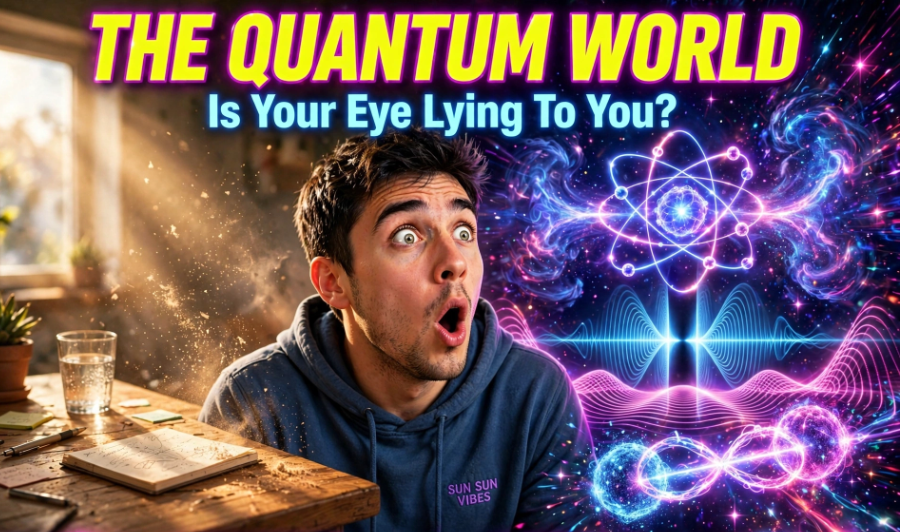
We often believe that the world around us exists exactly as we perceive it. A table is simply a table. Light is light. A tiny speck of dust is just a small object floating through the air.
But when scientists explore the incredibly small world of atoms and subatomic particles, familiar rules begin to behave in unexpected ways.
In this realm, light exhibits both wave-like and particle-like properties. Quantum systems can exist in superposition states. Two quantum systems can also share extraordinary correlations, even when separated by vast distances.
And an intriguing question emerges:
Is the world we see the entirety of reality, or merely one part of a much greater picture?

1. When Nature Defies Our Intuition
In everyday life, we are accustomed to classical physics. Objects have positions, velocities, and relatively predictable trajectories.
At the quantum scale, however, nature requires a very different description.
An electron is not simply a tiny ball orbiting an atomic nucleus. Quantum mechanics describes its state using a mathematical object called a wave function, which allows us to calculate the probabilities of finding the electron in different locations.
This does not mean that electrons are magical objects that disappear and reappear at will. Rather, it reveals that the intuition we develop from everyday experience is not sufficient to describe the microscopic world.
2. Can Something Behave Like Both a Wave and a Particle?
The double-slit experiment is one of the most fascinating demonstrations in quantum physics.
When electrons pass through two narrow slits, they can produce an interference pattern characteristic of waves, even when individual electrons are detected one at a time on a screen.
When an experimental setup is used to determine which slit an electron passes through, the interference pattern changes.
This raises a profound question: Why does measuring a quantum system affect the results we observe?
The experiment reveals something remarkable: the microscopic world does not behave according to the simple pictures we normally imagine.
3. Does Reality Exist Before We Observe It?
In quantum mechanics, measurement plays a special role.
Before measurement, a quantum system can be described as a superposition of different possible outcomes. When a measurement is performed, a particular result is obtained.
However, there is an important distinction to make:
- Observation in quantum physics does not necessarily mean a human looking at something with their eyes.
- Measurement involves physical interactions between a quantum system and a measuring device or its environment.
- Quantum mechanics does not prove that human consciousness creates reality.
Different interpretations of quantum mechanics offer different perspectives on what these mathematical descriptions mean.
The deeper question of what quantum theory tells us about the nature of reality remains an active subject of scientific and philosophical discussion.

4. A Connection Beyond Our Everyday Understanding
Quantum entanglement reveals that two or more quantum systems can share remarkably strong correlations, even when they are separated by enormous distances.
Experiments testing Bell inequalities have demonstrated that nature cannot be explained by certain simple models based on local hidden variables.
Albert Einstein famously described this phenomenon as “spooky action at a distance.”
Today, quantum entanglement is no longer merely a theoretical curiosity. It plays an important role in research into quantum communication, quantum cryptography, and emerging quantum technologies.
It offers a glimpse into how deeply interconnected the quantum world can be.
5. So, Is Reality What We See?
Perhaps the most interesting answer is not that the world we experience is an illusion.
Tables remain tables. The Sun continues to shine. Earth continues its journey around our star.
But what our senses reveal is only part of the natural world.
Quantum physics reminds us that reality can be far more complex than our everyday intuition suggests.
There is still no single interpretation of quantum mechanics universally accepted by all scientists. Yet this ongoing debate makes the journey of discovery even more fascinating.

A Universe of Questions Still Waiting to Be Explored
Perhaps we will never see the quantum world directly through our ordinary eyes.
Yet through mathematics, experiments, and scientific imagination, humanity continues to uncover the hidden structures beneath the familiar world.
And perhaps the greatest wonder is not simply how strange the quantum world can be, but that a small species on a tiny planet can ask questions about the fundamental nature of the entire universe.
Sometimes, reality is far more fascinating than what our eyes can see.
SUN SUN VIBES
A Little Universe of Ideas, Science & Life